

Two fundamentally different philosophies — and the right choice depends entirely on how the space will actually be used.
Walk into any interior design conversation today and you’ll almost certainly hear the phrase “open plan.” It has become the default aspiration — the layout of choice for modern homes, restaurants, offices, and retail spaces alike. But is it always the right answer?
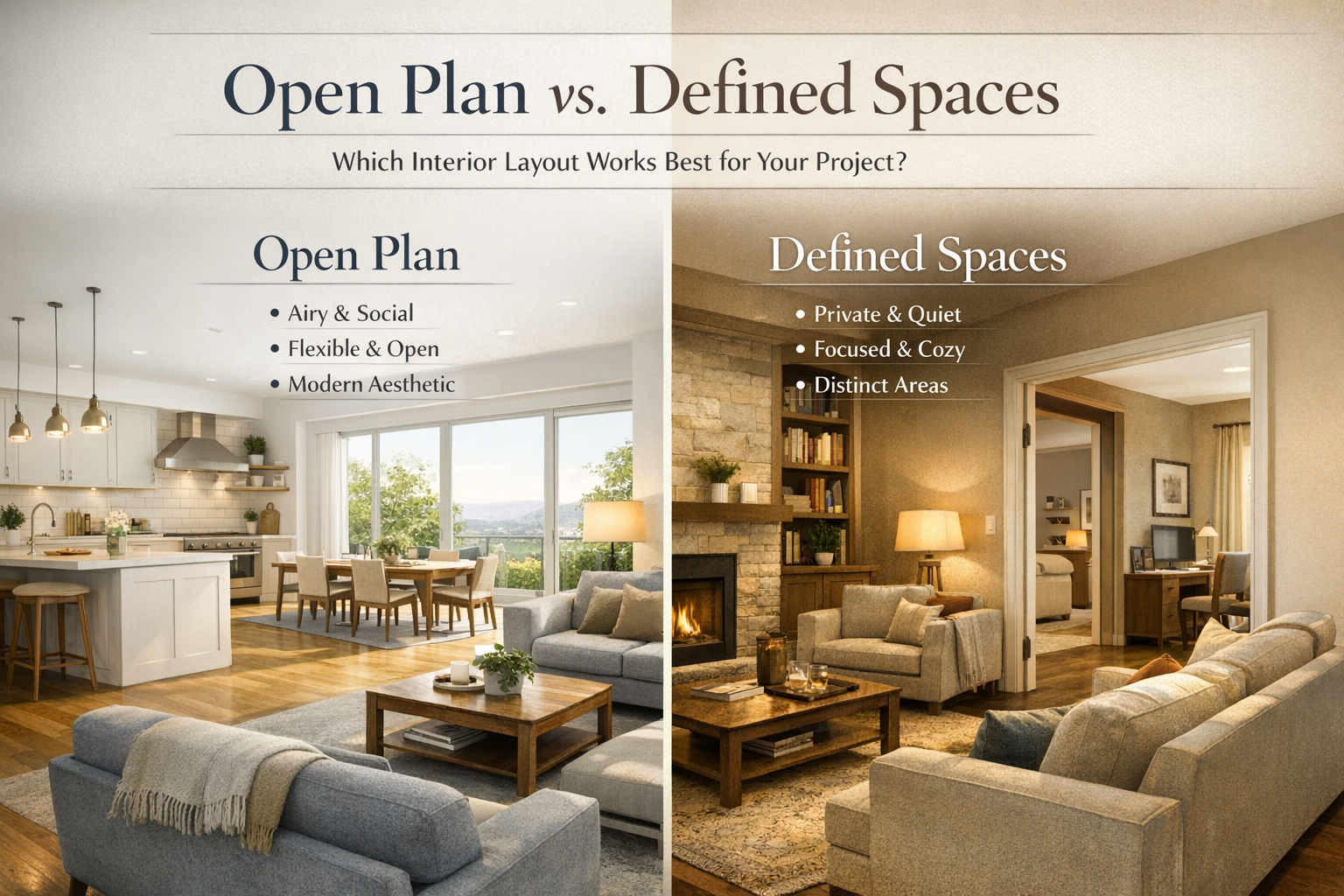
Not necessarily. Defined, compartmentalised spaces are making a strong return — and for good reasons. The debate between open-plan and defined spatial layouts isn’t just an aesthetic one. It’s a functional decision that shapes how people move, feel, and behave inside a space. Getting it right means understanding both approaches deeply — including their trade-offs.
In this guide, we break down what each layout style means, where each performs best, and how to make the right decision for your specific project — whether you’re designing a home, a commercial interior, or a hospitality space.
The Core Difference in One Sentence
Open-plan design removes barriers between functional zones, creating one continuous, shared space. Defined spatial design uses walls, partitions, or architectural elements to separate areas into distinct rooms or zones with clear boundaries.
Simple rule of thumb: If the priority is social connection, visual openness, and flexibility — open plan delivers. If the priority is acoustic privacy, focused functionality, or intimate atmosphere — defined spaces win.
What Is Open-Plan Design?
Open-plan design eliminates or minimises internal walls to create a flowing, interconnected interior. Living, dining, and kitchen areas merge in residential settings. In commercial contexts, workstations, collaboration areas, and communal zones blend without hard separation.
The appeal is clear and well-documented. Open-plan spaces:
- Maximise natural light penetration across the entire floor plate
- Create a sense of spaciousness, even in smaller square footages
- Encourage social interaction and visibility between occupants
- Allow flexible furniture arrangements and easy layout changes
- Suit contemporary aesthetics — clean lines, uninterrupted sightlines
It’s why open plan became the dominant residential trend through the 2000s and 2010s — and why it remains the go-to for modern office design, hospitality interiors, and high-end retail.
What Are Defined Spaces?
Defined spatial layouts use walls, full-height partitions, or deliberate architectural elements — arches, level changes, ceiling variations — to create distinct, contained zones within a building. Each room or area has a clear boundary and a primary function.
Defined spaces offer their own set of distinct advantages:
- Superior acoustic separation — noise stays contained within zones
- Stronger sense of intimacy, enclosure, and focus
- Better privacy for working, sleeping, or concentrated activity
- Easier thermal management — smaller spaces heat and cool more efficiently
- More opportunities for contrast — each room can have its own character and atmosphere
Defined layouts are also inherently more adaptable over time. A room with four walls can be repurposed far more easily than an open zone that requires the whole space to be rethought.
Head-to-Head Comparison
| Factor | Open Plan | Defined Spaces |
|---|---|---|
| Natural light | Excellent — light flows freely | Depends on window placement per room |
| Acoustic privacy | Poor — sound travels across zones | Excellent — walls contain noise |
| Social atmosphere | High — encourages interaction | Lower — people move between rooms |
| Visual spaciousness | Strong — uninterrupted sightlines | More intimate, less expansive |
| Design flexibility | High in early stages; harder later | Rooms can be redesigned independently |
| Thermal efficiency | Lower — larger volume to heat/cool | Better — zone-by-zone control |
| Best for | Social homes, hospitality, modern offices | Focus-heavy work, family homes, luxury hotels |
| Visual complexity | Risk of visual clutter if not managed well | Each room can have a distinct identity |
When to Choose Open Plan
Open plan is the right choice when the social and visual experience of the space is the primary driver.
Residential
- Couples or individuals without children at home
- Entertaining-focused households
- Smaller floor plans that need to feel larger
- Properties with exceptional views to frame
Commercial
- Collaborative offices and creative studios
- Casual dining and café concepts
- Retail with browse-friendly flow
- Showrooms and exhibition spaces
When to Choose Defined Spaces
Defined layouts perform best when distinct functions need to coexist without compromising each other.
Residential
- Families with children of different ages
- Home offices requiring concentration
- Multi-generational households
- Properties where sound management is critical
Commercial
- Law firms, clinics, and professional services
- Luxury hotel rooms and suites
- Fine dining and private dining experiences
- Offices requiring confidentiality
The Hybrid Approach: The Best of Both Worlds
In practice, most successful contemporary interiors don’t commit fully to one extreme. Skilled interior designers increasingly use hybrid layouts — open public zones that encourage interaction, with clearly defined private zones for focus and retreat.
A modern family home might keep the kitchen, dining, and living areas open to each other while using a defined study, children’s bedrooms, and a separate master suite. A restaurant might have an open dining floor but private dining rooms available for larger groups.
The design principle: Let the function guide the boundary. Where connection matters most, remove the walls. Where focus or privacy matters most, build them back in.
Zoning tools — changes in ceiling height, flooring material, lighting levels, or furniture arrangement — allow designers to create the psychological impression of defined spaces within an open plan. This is a sophisticated technique that, when done well, delivers the best of both worlds.
Why This Decision Should Be Visualised Before You Build
The single biggest mistake clients make with layout decisions is trying to imagine the outcome from a floor plan alone. A floor plan tells you where the walls go — it doesn’t tell you how the space will feel, how light will move through it at different times of day, or how the proportions will read when you’re standing inside it.
This is exactly where 3D architectural rendering becomes invaluable. A photorealistic render of both layout options — open plan versus defined — gives you a genuine visual reference before any structural decisions are made. You can test different materials, lighting scenarios, and furniture arrangements within each configuration. The decision moves from abstract to concrete.
At Arthitecture Design, we regularly produce side-by-side renders for clients weighing layout options — because seeing is the only reliable way to decide.
Frequently Asked Questions
Is open plan still popular, or is it declining?
Open plan remains widely used, but there’s a clear shift toward hybrid approaches — particularly in residential design. The pandemic years accelerated demand for home offices and acoustic privacy, and many clients now actively request defined zones within otherwise open layouts.
Does open plan add value to a property?
It depends on the market and property type. Open-plan kitchen-living spaces remain popular with buyers in many urban markets. However, properties with no private rooms at all can be harder to sell to family buyers. A well-executed hybrid often performs best across the widest buyer audience.
Can defined spaces still feel light and modern?
Absolutely. Defined spaces with generous windows, light finishes, and carefully considered doorway proportions can feel just as bright and contemporary as open-plan layouts. The key is treating each room as a complete design composition in its own right.
How do I zone an open-plan space without adding walls?
The most effective zoning tools are changes in flooring material or colour, ceiling height variations, distinct lighting schemes per zone, and strategic furniture placement — particularly rugs, which act as visual anchors for each area. A skilled designer can create strong spatial definition without a single partition.
At what stage should layout decisions be made?
As early as possible — ideally before any structural or planning work begins. Layout is the hardest and most expensive thing to change later. This is why 3D visualisation at the concept stage is so valuable: it lets you test and confirm the layout decision before you’re committed to it.
Not Sure Which Layout Is Right for Your Project?
At Arthitecture Design, we help architects, developers, and property owners visualise layout options before anything is built. Let us show you both approaches — side by side, in full photorealistic detail.