
If you’ve ever searched for ways to market a property or present a design concept visually, you’ve probably come across both terms: virtual staging and 3D rendering. They sound similar. They both produce stunning, realistic images. And yes, they’re both powered by digital technology.
But they are fundamentally different tools — and choosing the wrong one for your project can cost you time, money, and missed opportunities.
In this guide, we break down exactly what each technique is, when to use each one, and how to make the right choice for your specific situation — whether you’re a real estate agent, property developer, architect, or interior designer.
The Core Difference in One Sentence
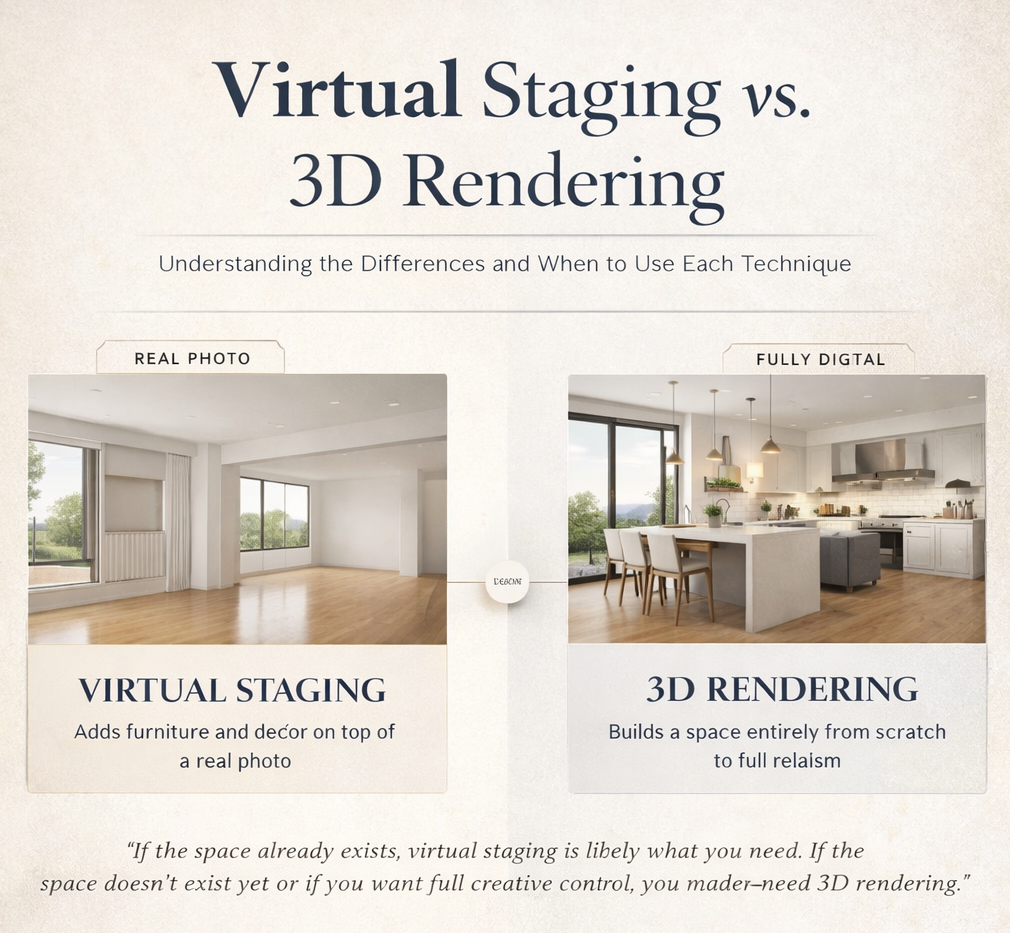
Virtual staging starts with a real photograph of an existing space and adds digital furniture and décor on top of it. 3D rendering builds the entire space from scratch using architectural plans — no physical space or photograph needed.
Simple rule of thumb: If the space already exists and you have photos of it, virtual staging is likely what you need. If the space doesn’t exist yet — or if you want full creative control over every detail — you need 3D rendering.
What Is Virtual Staging?
Virtual staging is the process of taking real photographs of an empty or sparsely furnished property and digitally inserting furniture, décor, lighting fixtures, and other design elements to make the space feel lived-in and inviting.
It’s widely used in real estate marketing — particularly for:
- Empty apartments and homes that need to look appealing in online listings
- Rental properties being marketed between tenants
- Newly completed developments where physical furniture hasn’t been installed
- Properties with outdated furnishings that need a fresh, modern look
The key advantage of virtual staging is speed and cost. Because it works from existing photos, turnaround is fast — often within a few days — and pricing is significantly lower than full 3D rendering.
What Is 3D Rendering?
3D rendering — also called architectural visualization or CGI — creates a fully computer-generated image of a space. A 3D artist builds the geometry of the room digitally, applies materials and textures, sets up lighting, and produces a final image that looks photographic but is 100% computer-generated.
3D rendering is the tool of choice when:
- The property or space doesn’t exist yet (off-plan sales, new builds, renovations)
- You need complete creative control over lighting, materials, and atmosphere
- You want to market a project before construction is finished
- You need images for investor presentations, planning applications, or brochures
- The design itself is the product — for architects, developers, and interior designers
Key insight: 3D rendering doesn’t just show what a space looks like — it communicates design intent. That’s why architects and developers rely on it to get approvals, secure funding, and sell units before a single wall goes up.
Head-to-Head Comparison
| Factor | Virtual Staging | 3D Rendering |
|---|---|---|
| Starting point | Real photo of existing space | Architectural plans or sketches |
| Space must exist? | Yes | No — works before construction |
| Turnaround time | Hours to a few days | 4–7+ business days |
| Cost | Lower | Higher — but more flexible |
| Creative control | Limited to the photo’s fixed angles and lighting | Complete — any angle, any lighting |
| Design changes | Furniture & décor only | Walls, layout, materials, everything |
| Best for | Property listings, rental marketing | Architecture, new builds, design presentations |
| Marketing use | Online listings, social media | Brochures, investor packs, website, social |
When to Choose Virtual Staging
Virtual staging is right if: your property is already built, you have good quality photos of the empty space, your goal is a quick and cost-effective listing, or you’re a real estate agent marketing multiple rooms fast.
When to Choose 3D Rendering
3D rendering is right if: the space doesn’t exist yet, you’re planning a renovation or new build, you need to present a concept to investors, you want full control over lighting and materials, or you need images before construction finishes.
Can You Use Both? Yes — And It Makes Sense
Virtual staging and 3D rendering aren’t rivals — they’re complementary tools that serve different phases of a project lifecycle.
Consider a property developer building a 20-unit residential complex. Before construction, they commission full 3D renderings to market the apartments off-plan — securing reservations and presenting to investors. Once the building is complete, they use virtual staging on actual photos of the empty units to list the remaining stock quickly and at lower cost.
The smart approach: Use 3D rendering to sell the vision before it’s built. Use virtual staging to sell the reality once it’s finished.
A Note on Quality
Both techniques can produce stunning, photorealistic results — but the quality ceiling is higher with 3D rendering. Because every element is built and lit digitally, a skilled 3D artist has complete control over the final image. Virtual staging, while faster and more affordable, is constrained by the original photograph — its angle, its light, its perspective.
For high-stakes presentations — investor pitches, luxury property marketing, architectural competitions — 3D rendering consistently delivers the more impactful result.
Frequently Asked Questions
Is virtual staging misleading to buyers?
Only if it’s not disclosed. Best practice — and in many markets, legal requirement — is to label virtually staged images clearly. When disclosed properly, it’s a fully accepted and widely used marketing tool.
Can 3D rendering be used for existing spaces, not just new builds?
Absolutely. Architects and designers regularly use 3D rendering to visualize renovation concepts — showing clients exactly how a space will look after a remodel, before a single wall is touched.
How long does each process take?
Virtual staging is typically completed within 24–72 hours for standard rooms. A single 3D interior render usually takes 4–7 business days, depending on complexity. Larger projects take longer — timelines are always agreed upfront.
Which one is better for social media marketing?
Both work well. Virtual staging is ideal for quick, high-volume listing content. 3D rendering is better for hero images and campaign visuals where you want maximum visual impact and full brand control.
Not Sure Which One You Need? Let’s Talk.
At Arthitecture Design, we specialize in photorealistic 3D rendering for architectural and commercial projects. If you’re not sure whether virtual staging or a full 3D render is right for your project, we’re happy to advise — no obligation.