
You’ve got the concept. The name, the menu, the vibe. You’ve signed the lease and hired a contractor. But here’s the question every restaurant owner dreads: will it actually look the way you imagined?
The gap between what you picture in your head and what ends up being built has cost countless owners thousands of dollars in redesigns, wrong furniture orders, and lighting setups that kill the mood instead of creating it.
That’s exactly where 3D restaurant interior rendering changes everything.
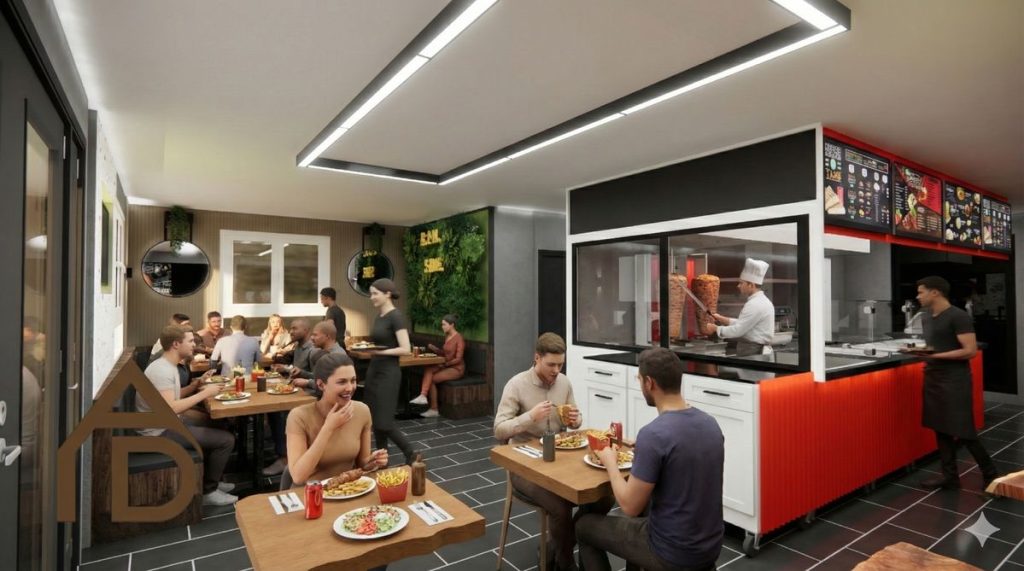
Photorealistic 3D restaurant interior rendering — visualize your space before construction begins.
What Is 3D Restaurant Interior Rendering?
3D restaurant interior rendering is the process of creating a photorealistic digital image of your restaurant space — before it’s built. Using professional software, a visualization studio takes your floor plans, material preferences, and design ideas and transforms them into images that look like actual photographs of a finished space.
These aren’t rough sketches or mood boards. We’re talking about images where you can see:
- The exact texture of your bar counter — marble, wood, concrete
- How the pendant lights cast warm pools of light over your tables
- Whether your seating arrangement feels open and airy or cozy and intimate
- What your entrance looks like from the door, in both daylight and evening ambiance
- How your branding, signage, and color palette come together in the real space
Pro Tip: A professional 3D rendering can also be used before you finalize any contracts — giving you the power to adjust your design at the cheapest possible stage.
Why Restaurant Owners Are Investing in 3D Visualization in 2026
The hospitality industry has never been more competitive. Customers don’t just choose a restaurant for the food — they choose it for the experience. Here’s why forward-thinking owners are making 3D rendering a standard part of their pre-construction process:
1. Avoid Costly Construction Mistakes
Changing a layout or materials after construction has begun can cost thousands. With a 3D rendering, you catch problems at the design stage — when changes cost nothing but a revision request. Imagine realizing the booth-style seating creates a cramped atmosphere, or that dark wood paneling makes the space feel like a cave. In a rendering, you fix it in days. In real life, you demolish and rebuild.
2. Get Everyone on the Same Page
Whether presenting to a business partner, a bank, or your interior designer, 3D renders eliminate the ambiguity of verbal descriptions and 2D blueprints. Everyone sees the same thing — your exact vision, in full detail.
3. Use Stunning Visuals for Marketing Before You Even Open
One of the most underused benefits of 3D rendering is marketing. With photorealistic images, you can:
- Launch your Instagram or website before construction is finished
- Run pre-opening reservation campaigns with real-looking interior shots
- Attract press coverage and food bloggers before day one
- Build social media buzz with ‘sneak peek’ posts
Real Example: Restaurants that share high-quality 3D renders on social media during build-out regularly report faster follower growth and reservation inquiries months before opening day.
4. Design the Perfect Atmosphere — Not Just the Layout
Great restaurant design isn’t just about where the tables go. It’s about how the space feels. With 3D visualization, you can test different lighting scenarios and compare material choices side by side. Want to see if rustic wood shelving works better than industrial metal? Render both.
5. Validate Your Concept with Real Customers
Some owners share draft renders with loyal customers or social media followers before finalizing their design. The feedback loop is invaluable — and it creates excitement among your future regulars.
3D Rendering vs. Traditional Blueprints
| Feature | Traditional Blueprints | 3D Rendering |
|---|---|---|
| Visual realism | Technical lines only | Photorealistic images |
| Non-designer friendly | Difficult | Immediately clear |
| Lighting visualization | Not possible | Fully simulated |
| Marketing use | Not suitable | Social, web, press ready |
| Error detection | Late (during build) | Early (at design stage) |
| Design iterations | Slow and costly | Fast and flexible |
Frequently Asked Questions
Do I need detailed architectural plans to get started?
Not necessarily. A basic floor plan, some inspiration images, and notes about materials and style are usually enough. The more detail you provide, the faster and more accurate the result.
Can I use 3D renders for my restaurant’s social media and website?
Absolutely. High-resolution renders can be used across Instagram, Facebook, your website, press releases, and printed materials. They’re designed to look like real photography.
Can I request changes after seeing the first draft?
Yes — revisions are a standard part of the process. Common requests include changing furniture, adjusting lighting warmth, swapping materials, or experimenting with a different color scheme.
Is 3D rendering only for new builds?
No — renovations benefit just as much. It’s especially useful for seeing how new elements will interact with the parts of your space that aren’t changing.
Ready to See Your Restaurant Before You Build It?
At Arthitecture Design, we specialize in photorealistic 3D rendering for restaurant and commercial interiors. Send us your floor plan and let us show you what’s possible — before a single wall goes up.