

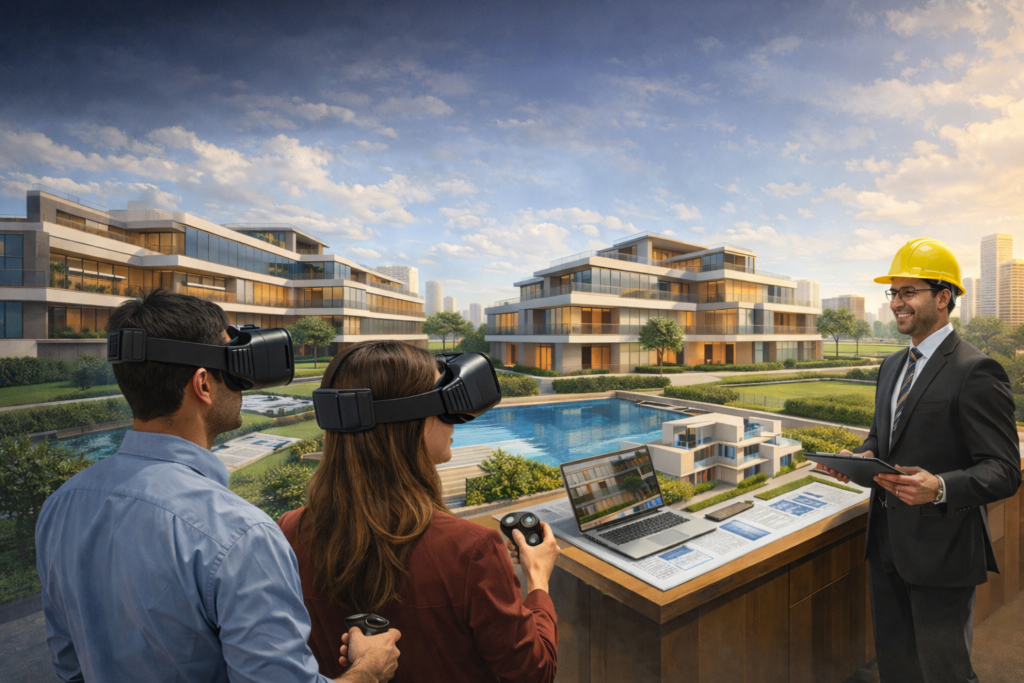
Imagine standing in the middle of your future home, walking through each room, feeling the scale of the space, and experiencing the play of natural light—all before a single brick is laid. This is no longer science fiction. The convergence of 3D architectural visualization and virtual reality (VR) technology has fundamentally transformed how architects present their ideas and how clients experience their future spaces. What was once confined to flat screens and static images has evolved into an immersive, interactive journey that changes everything about the design approval process.
Beyond the Screen: Why VR Changes the Game
Traditional presentation methods—whether physical models, printed renders, or even high-quality digital images—share a fundamental limitation: they ask clients to imagine themselves in a space rather than actually experience it. Virtual reality removes this barrier entirely, creating a paradigm shift in how architectural design is understood and evaluated.
1. True Spatial Understanding: Seeing Is Believing, But Being Is Knowing
One of the most persistent challenges in architecture is helping clients understand scale and proportion. A room that looks spacious on paper might feel cramped in reality, or vice versa. Even the best photorealistic renders, viewed on a screen, cannot fully convey the three-dimensional experience of being in a space.
VR solves this problem completely. When a client puts on a VR headset and steps into their future space, they instantly understand dimensions, ceiling heights, sightlines, and spatial relationships in a way that no other medium can provide. This eliminates one of the biggest sources of post-construction disappointment and ensures that design decisions are made with complete confidence.
2. Emotional Connection and Decision Confidence
Buying a property or approving a major architectural project is as much an emotional decision as it is a rational one. People need to feel at home in a space, not just understand its specifications. VR creates that emotional connection in a powerful, immediate way.
Walking through a virtual version of your future home, seeing how morning light fills the kitchen, or experiencing the view from the master bedroom window creates a visceral, emotional response that flat images simply cannot match. This emotional engagement dramatically accelerates decision-making and increases client satisfaction and commitment.
3. Real-Time Design Iteration and Collaboration
Modern VR systems integrated with architectural visualization software allow for real-time modifications during presentations. A client wants to see what the living room looks like with a different wall color? Change it instantly. Curious about moving a wall or trying a different flooring material? Make the adjustment on the spot.
This level of interactivity transforms the client meeting from a passive presentation into an active collaboration. Clients become co-creators in the design process, leading to outcomes they are truly invested in and excited about.
The Technology Behind the Magic: How It Works
The integration of VR into architectural workflows is more accessible than many professionals realize. The core process involves taking an existing 3D architectural model—the same model used to create traditional renders—and optimizing it for real-time rendering in VR.
Modern VR-ready rendering engines can handle complex architectural models with realistic materials, accurate lighting, and even ambient sounds. The result is an experience that feels remarkably close to being in the actual completed space. As the technology continues to evolve, the gap between virtual and physical reality continues to narrow.
Practical Applications: Where VR Delivers Maximum Impact
While VR can enhance virtually any architectural project, certain scenarios benefit most dramatically from this technology:
Luxury Residential Projects: High-net-worth clients expect cutting-edge presentation methods and the ability to customize every detail. VR meets both expectations while justifying premium pricing.
Pre-Construction Sales and Marketing: Developers can open virtual showrooms long before physical ones are ready, accelerating sales cycles and improving cash flow. Potential buyers can tour multiple unit types and customize finishes without leaving the sales office.
Complex Commercial Spaces: For restaurants, hotels, retail stores, and corporate offices where ambiance and customer flow are critical, VR allows stakeholders to experience and refine these elements before construction begins.
Remote Collaboration: When clients, architects, and consultants are in different locations, VR provides a shared experience that goes far beyond video calls and screen sharing. Everyone can be “in” the same space simultaneously, regardless of physical location.
Overcoming the Adoption Barrier: Is VR Worth the Investment?
For firms considering adding VR to their services, the question of cost and complexity naturally arises. The reality is that the barriers to entry have dropped dramatically in recent years. High-quality VR headsets are now affordable, and the software integration with existing 3D visualization workflows is increasingly seamless.
More importantly, the competitive advantage and client satisfaction gains make VR a strategic investment rather than a cost. Firms that offer VR presentations consistently report higher close rates, fewer design revisions, and stronger client relationships. In a competitive market, these advantages quickly translate into business growth and profitability.
The Human Factor: Technology That Enhances, Not Replaces
It is important to note that VR does not replace the architect’s expertise or the traditional design process. Rather, it is a powerful communication tool that allows that expertise to be more effectively shared and understood. The architect remains the guide, the expert, and the creative force—VR simply ensures that their vision is communicated with perfect clarity.
Looking Ahead: The Evolution Continues
VR in architecture is still in its early stages, and the technology continues to advance rapidly. Emerging developments include haptic feedback (feeling textures and surfaces), multiplayer VR (allowing multiple stakeholders to explore a space together simultaneously), and AI-assisted design iteration based on user behavior in VR environments.
The future of architectural presentation will likely blend physical, digital, and virtual experiences into a seamless continuum. Firms that embrace these technologies early will be best positioned to lead the industry forward.
Conclusion: The Competitive Edge Is Immersive
In an industry where differentiation is increasingly difficult, VR-enhanced architectural visualization offers a clear competitive advantage. It transforms client meetings from presentations into experiences, reduces uncertainty, accelerates decisions, and creates deeper emotional connections with designs.
The question is no longer whether VR will become standard in architectural practice, but how quickly firms will adopt it to stay competitive. Those who move first will set the standard that others will struggle to match.
Contact us to learn more about our photorealistic 3D visualization services for your project and to create the space of your dreams together.
[…] or landmark structures; it has become an essential tool that is redefining the boundaries of what architecture can […]