
In the early stages of an architectural project, every line item on the budget is scrutinized. When faced with cost pressures, some decision-makers view 3D architectural visualization as an optional luxury—something that can be cut to save money. However, this seemingly prudent decision often becomes one of the most expensive mistakes a project can make. The hidden costs of skipping visualization far exceed the initial savings, creating financial and operational consequences that ripple throughout the entire project lifecycle.
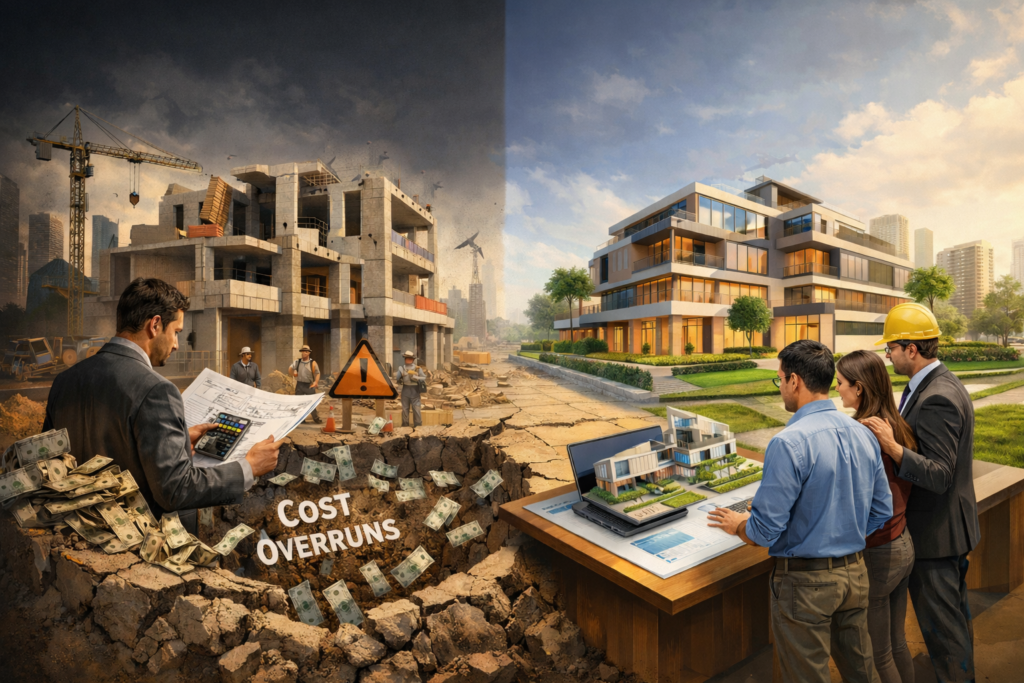
The False Economy: Why “Saving” on Visualization Costs More
The logic seems straightforward: why spend money on digital images when you already have blueprints and floor plans? The answer lies in understanding what happens when stakeholders cannot visualize the final result.
1. Design Revisions During Construction: The Most Expensive Changes
Without photorealistic renders, design flaws and miscommunications often go unnoticed until construction begins. At this stage, making changes becomes exponentially more expensive. What would have been a simple digital adjustment becomes a costly demolition, material waste, and timeline delay.
Consider a common scenario: A client approves a design based on 2D plans, but when the walls go up, they realize the space feels cramped or the material choices clash. The result? Costly rework that could have been entirely avoided with a single high-quality 3D render showing the exact spatial relationships and material combinations.
Industry data consistently shows that changes made during the design phase cost a fraction of changes made during construction. A $2,000 investment in comprehensive 3D visualization can easily prevent $50,000 or more in construction-phase modifications.
2. Lost Sales and Marketing Opportunities
For developers and investors, the ability to pre-sell or lease a property before completion is critical for cash flow and project viability. Without compelling 3D renders, this becomes nearly impossible.
Potential buyers and tenants need to emotionally connect with a space before committing. Technical drawings simply cannot create that connection. As a result, properties without professional visualization often sit on the market longer, require price reductions, or fail to attract premium buyers. The opportunity cost of delayed sales or reduced pricing quickly dwarfs the modest investment in quality rendering.
3. Stakeholder Misalignment and Approval Delays
Every additional stakeholder in a project—whether an investor, planning committee, or corporate board—adds complexity to the approval process. When each party interprets 2D plans differently, reaching consensus becomes a lengthy, frustrating process.
High-quality 3D visualization eliminates ambiguity. Everyone sees the exact same vision, leading to faster approvals, fewer meetings, and reduced administrative overhead. Time is money, and visualization saves both.
The Ripple Effect: How Visualization Prevents Downstream Problems
The benefits of 3D rendering extend far beyond the design phase. They create value throughout the project timeline in often-overlooked ways.
Contractor Clarity and Reduced Errors
Contractors and subcontractors work more efficiently when they have a clear visual reference. Detailed renders reduce on-site confusion, minimize installation errors, and decrease the need for costly clarification meetings. This translates directly into labor cost savings and faster project completion.
Material Optimization and Waste Reduction
When materials are visualized in context before ordering, you can make more informed decisions about quantities, finishes, and alternatives. This reduces over-ordering, minimizes waste, and allows for value engineering without compromising the design vision. The environmental and financial benefits are substantial.
Future-Proofing Design Decisions
A comprehensive 3D model becomes a valuable asset for future renovations, expansions, or property management. Instead of working from outdated or incomplete documentation, facility managers and future architects have an accurate digital twin to reference. This long-term value is often completely overlooked in initial budget discussions.
Real-World Applications: Where Visualization Delivers Maximum ROI
While every project benefits from 3D visualization, certain types see particularly dramatic returns on investment:
Large-Scale Developments: Where a single design flaw can multiply across dozens of identical units, the cost of getting it wrong is catastrophic. Visualization ensures perfection before mass production begins.
High-End Residential Projects: Where clients have exacting standards and the cost of dissatisfaction is reputational damage and legal disputes. Visualization manages expectations and ensures satisfaction.
Commercial and Retail Spaces: Where brand identity and customer experience are paramount. Visualization allows for testing different layouts, lighting scenarios, and branding elements before committing to expensive installations.
Public and Institutional Buildings: Where multiple approval layers and public scrutiny require crystal-clear communication. Visualization accelerates the bureaucratic process and builds public support.
The Investment Mindset: Understanding True Project Costs
Forward-thinking clients and architects understand that 3D visualization is not a cost—it is an investment with measurable returns. The real question is not “Can we afford visualization?” but rather “Can we afford not to visualize?”
A typical high-quality 3D visualization package might represent just 1-2% of a project’s total budget. Yet, it can prevent issues that cost 10-20% or more in overruns, delays, and lost opportunities. From a pure financial perspective, this is one of the highest-return investments available in the construction process.
Conclusion: Visualization Is Risk Management
In the complex world of architectural projects, uncertainty is expensive. Every ambiguity, every miscommunication, and every design flaw that reaches the construction phase multiplies in cost. 3D architectural visualization eliminates these risks before they become real problems.
The projects that succeed are those that invest strategically in clarity, communication, and confidence. Visualization provides all three. It is not about creating beautiful images—though it does that too—it is about building better projects, faster and more profitably.
Contact us to learn more about our photorealistic 3D visualization services for your project and to create the space of your dreams together.
[…] Diverse Applications Across Building Types […]